

Beyond microchannels: How airborne cell sorting breaks traditional limits
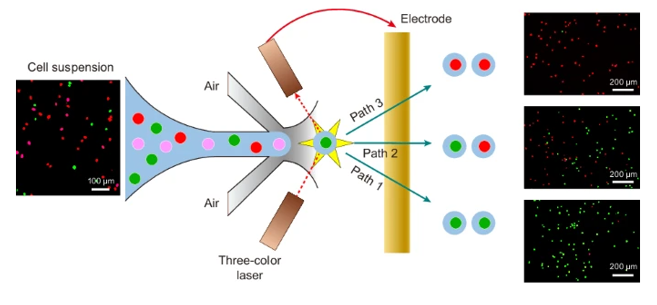
Channel-Free Single-Cell Sorting in Air with Tunable Paths.
FAYETTEVILLE, GA, UNITED STATES, February 7, 2026 /EINPresswire.com/ -- Accurately isolating individual cells from complex biological samples is essential for modern biomedical research, yet existing sorting technologies face trade-offs between precision, flexibility, and cell viability.
Single-cell technologies have transformed biological research by revealing cellular heterogeneity that bulk measurements cannot capture. Widely used methods such as fluorescence-activated cell sorting and magnetic sorting can process large numbers of cells, but they often compromise cell viability, require labeling steps, or provide limited sorting accuracy. Microfluidic sorting offers improved precision, yet conventional designs rely on rigid channels that restrict sorting paths and require additional processing to recover cells. These limitations hinder flexible, multipurpose sorting from complex samples. Based on these challenges, there is a clear need to develop a more adaptable and gentle single-cell sorting strategy capable of high accuracy without the constraints imposed by fixed microfluidic channels.
Researchers from Beihang University report a new microfluidic platform that enables precise sorting of single cells in air, rather than inside conventional liquid-filled channels. The study, published (DOI: 10.1038/s41378-025-01024-z) on November 2025 in Microsystems & Nanoengineering, demonstrates that individual cells can be encapsulated in droplets, ejected into air along controllable paths, and selectively sorted using electrical forces. By freeing cell sorting from solid channel walls, the system achieves greater flexibility while maintaining high accuracy and cell survival. The work introduces a new direction for microfluidic cell manipulation and single-cell isolation.
At the core of the new system is a microfluidic device that generates droplets containing single cells using a co-flow of air and liquid. By precisely adjusting the pressure balance between two air streams, droplets can be ejected into air at different angles, creating multiple independent sorting paths in real time. This tunable ejection replaces fixed channel geometries and allows sorting routes to be reconfigured during operation.
Once airborne, the droplets pass through a sorting zone equipped with a specially designed cylindrical electrode. This electrode generates a uniform dielectrophoretic force capable of deflecting droplets regardless of their incoming direction. When a droplet containing a target cell is detected by fluorescence signals, the electric field is briefly switched off, allowing the droplet to continue along its original path. Non-target droplets are deflected into waste collection.
Using this approach, the researchers achieved sorting accuracies exceeding 99% across all tested paths, with cell survival rates above 92%. Importantly, the system was able to separate multiple cell subpopulations simultaneously from a mixed sample in a single run. Compared with traditional methods, the airborne sorting process applies lower mechanical stress, reducing damage to cells while preserving high precision. Together, these results demonstrate a robust and flexible platform for high-performance single-cell sorting.
“This work bridges the gap between the precision of microfluidic sorting and the flexibility of flow cytometry,” said the study’s lead investigator. “By removing the physical constraints of microchannels, we can dynamically control where each single cell goes, without sacrificing accuracy or viability. This capability is particularly important for applications that require isolating multiple cell types from complex samples, such as cancer diagnostics or immune profiling. We believe this technology represents a meaningful step toward more adaptable and user-defined single-cell sorting systems.”
The ability to sort single cells along multiple paths in air has broad implications for biology and medicine. The platform could enable simultaneous isolation of different cell populations from patient samples, accelerating workflows in diagnostics, drug screening, and personalized medicine. Its gentle handling of cells makes it suitable for downstream culture, genetic analysis, or functional assays. With further integration of additional optical channels or imaging-based detection, the system could expand to even more complex sorting tasks. Ultimately, this approach lays the groundwork for next-generation single-cell technologies that are more flexible, scalable, and adaptable to real-world biomedical challenges.
References
DOI
10.1038/s41378-025-01024-z
Original Source URL
https://doi.org/10.1038/s41378-025-01024-z
Funding Information
This work was supported by the National Natural Science Foundation of China (Grant no. 52475584, 52205296), National Key R&D Program of China (Grant no. 2025YFC3408703) and Aeronautical Science Foundation of China (Grant Number 2023Z056051001).
Lucy Wang
BioDesign Research
email us here
Legal Disclaimer:
EIN Presswire provides this news content "as is" without warranty of any kind. We do not accept any responsibility or liability for the accuracy, content, images, videos, licenses, completeness, legality, or reliability of the information contained in this article. If you have any complaints or copyright issues related to this article, kindly contact the author above.
